Anchore Enterprise makes software composition visible and manageable at scale — supporting the full Software Bill of Materials (SBOM) lifecycle across container images, filesystems, and externally supplied SBOMs from third-party vendors and open-source suppliers.
It brings together the tools and workflows needed to add, organize, analyze, and monitor SBOM data, including:
Adding SBOMs from build pipelines, registries, and external tools
Organizing SBOMs into versioned apps for portfolio-level visibility
Analyzing SBOMs for vulnerability and compliance risk
Observing app health across the software delivery lifecycle
Exporting SBOMs in industry-standard formats for downstream consumers
SBOMs as a Source of Truth
In Anchore Enterprise, the SBOM is the authoritative record of what a software artifact contains. All security analysis, policy enforcement, and compliance evaluation operate against SBOM data — making the SBOM the single reference point for understanding software composition across the supply chain.
The reliability of every security and compliance result depends on the accuracy and completeness of the underlying SBOM. Gaps in coverage or missing metadata translate directly into gaps in security visibility — making SBOM quality a foundational concern for any software assurance program.
Add SBOMs to Apps
Anchore Enterprise organizes SBOM data around a three-level hierarchy: an application (app) represents a piece of software you ship or host, an application version captures a point-in-time release of that application, and each application version contains one or more assets — the concrete things that were analyzed. See How It Works for the full model.
You add SBOMs by attaching an asset to an application version. AnchoreCTL exposes three asset-add paths:
Existing SBOMs — upload a CycloneDX, SPDX, or Syft-native JSON document produced outside Anchore Enterprise. See Managing SBOM Assets.
Container images — analyze an image either locally with AnchoreCTL or by handing the reference to Anchore Enterprise for server-side analysis. See Managing Container Image Assets.
Filesystems — analyze a local directory (i.e., source repo, build artifact dir, or a mounted VM) and upload the resulting SBOM as an asset. See Managing Filesystem Assets.
Anchore Enterprise validates uploaded SBOMs for schema correctness and required content before accepting them for vulnerability and policy analysis.
Coming soon: standalone SBOM generation — producing an SBOM locally without sending it to Anchore Enterprise. See Generate SBOMs.
Organize SBOMs Into Apps
Anchore Enterprise organizes SBOMs into apps that model how your teams build and deliver software. An app represents the top-level building block in a hierarchical view and can contain multiple versions, each holding the container images, filesystems, and externally supplied SBOMs that belong to that release.
You can:
Create apps and app versions to track security health across the release lifecycle
Attach assets to an app version as a release takes shape
Browse package, vulnerability, and policy data aggregated across every asset in a version
Pivot from a finding back to the assets that contain the affected package
Anchore Enterprise continuously analyzes asset SBOMs for vulnerability and compliance risk.
You can:
Queue assets for vulnerability scanning, with automatic re-scans as new vulnerability data becomes available
Filter and prioritize vulnerability findings by age, minimum severity, and minimum CVSS score using the Anchore Score — a composite index of CVSS score and severity, EPSS percentage, and CISA KEV status
Evaluate policy compliance across every asset in an app version, with results showing the final action, evaluation outcome, and a summary of findings by action, vulnerability severity, and allowlisted findings
Anchore Enterprise provides a portfolio-level view of what your apps contain through the View Contents capability, and of their security findings through Scan an App Version.
From an app version, you can:
List the assets that make up a version and inspect each one in turn
Browse aggregated packages and vulnerabilities for the version, then pivot to the assets that contain a given package
Review SBOMs, vulnerability findings, and policy evaluation results for individual assets
Export SBOMs and Security Reports
Anchore Enterprise produces combined downstream artifacts in standard formats.
You can:
Export a combined SBOM for an app version in CycloneDX 1.6 or SPDX 2.3 format containing all packages across all contained assets
SBOM management in Anchore Enterprise covers the full Software Bill of Materials (SBOM) lifecycle, from adding SBOMs to a release through organization, vulnerability scanning, and compliance evaluation. Each SBOM is attached to an app version as an asset, and Anchore Enterprise aggregates package, vulnerability, and policy data across every asset in a version so you can see, and act on, the security posture of a release as a whole.
Specific topics related to the SBOM management framework can be referenced per the links below:
Anchore Enterprise organizes SBOM data around a three-level hierarchy:
App — the top-level entity representing a piece of software you ship or host. An app carries a name, a description, a contact, and an optional default policy that applies to every version for that application.
App Version — a point-in-time release of an app. A version carries a name (typically a semver or release tag), an optional description, an optional reference to the previous version, an optional release date, and a status (in_progress, released, or eol).
Asset — a concrete thing that was analyzed and whose SBOM lives inside an app version. An app version can hold any number of assets: a container image, a filesystem analysis, an externally supplied Syft (native), CycloneDX, or SPDX document, or any mix of these.
The app version is the unit of aggregation: when Anchore Enterprise reports the packages, vulnerabilities, or policy status of “a release,” it is summarizing across the assets attached to a version.
Asset Types
Every asset has a type that describes what the SBOM represents. The supported types are:
container — a container image
filesystem — an analyzed directory tree
application, library, module, file, firmware, device, virtual_machine_disk — finer-grained classifications used primarily by externally supplied SBOMs that follow the CycloneDX component-type taxonomy
unknown — to be used when the type is not known
The three AnchoreCTL asset add commands allow the user to specify the asset type (what codebase element it represents) with the --type parameter. For app version asset add container-image, the --type parameter is defaulted to container and for app version asset add sbom it is defaulted to unknown.
The Asset Lifecycle
Adding an asset is an asynchronous operation. AnchoreCTL or the API submits a job that analyzes the artifact and generates the SBOM (or uploads the SBOM if external), processes the SBOM contents, and attaches the resulting asset to the named app version.
A job moves through the following states:
pending — accepted, waiting for a worker
processing — actively being analyzed
complete — finished successfully; the asset is queryable
failed — terminated with an error captured on the job record
cancelled — terminated by user request
You can wait for a job to finish (--wait on the CLI) or poll the job endpoint until status reaches a terminal state. Once an asset is complete, its SBOM, packages, vulnerabilities, and policy findings are queryable through the app-version endpoints.
Centralized and Distributed Analysis
Container images can be analyzed in two ways:
Centralized analysis (anchorectl app version asset add container-image-remote) — Anchore Enterprise pulls the image from your registry and analyzes it server-side. The SBOM is produced inside Anchore Enterprise.
Distributed analysis (anchorectl app version asset add container-image) — AnchoreCTL pulls or reads the image where you run the command, generates the SBOM locally, and uploads the result. Anchore Enterprise never sees the image bytes.
Both paths produce the same kind of asset. The trade-off is where the SBOM-generation work runs: centralized analysis runs it inside the Anchore Enterprise deployment, while distributed analysis runs it on the host where AnchoreCTL is invoked. Use distributed analysis to keep image-analysis load off the central deployment. This is useful when CI runners have spare capacity, when the central deployment is sized for evaluation and aggregation rather than analysis throughput, or when image bytes shouldn’t leave the build host (air-gapped or sensitive-image pipelines).
For the full mechanics, including diagrams, a worked CLI example, and the stateless one-time-scan variant, see Centralized and Distributed Analysis.
Supported SBOM Formats
SBOMs uploaded via app version asset add sbom are validated for schema correctness before the job moves out of pending. The supported formats are:
Format
JSON versions
XML versions
Tag-Value versions
CycloneDX
1.2 – 1.7
1.0 – 1.7
—
SPDX 2.x
2.2 – 2.3
—
2.1 – 2.3
SPDX 3.0
3.0
—
—
Syft
native
—
—
SPDX 3.0 documents can be uploaded and downloaded today, but content and vulnerability analysis against them are not yet functional.
For the validation pipeline each upload passes through, see Managing SBOM Assets.
Unified Data Queries Across an App Version
Once an app version contains one or more assets, Anchore Enterprise exposes unified data queries that combine deduplicated data from every asset in the version:
List packages in a version — GET /apps/{app_id}/versions/{version_id}/packages
List vulnerabilities in a version — GET /apps/{app_id}/versions/{version_id}/vulnerabilities
Find assets that contain a given package — GET /apps/{app_id}/versions/{version_id}/assets-by-package?name=...&version=...
Find packages affected by a given vulnerability — GET /apps/{app_id}/versions/{version_id}/packages-by-vulnerability
These unified data queries are the practical reason to group assets under an app version: they let you answer “which images in this release contain openssl 3.0.13?” with one request.
API Conventions
Every entity carries a system_metadata envelope with a UUID id and RFC 3339 created_at/updated_at timestamps.
Pagination
Collection endpoints return paginated responses. The limit query parameter sets the page size (default and maximum 1000).
Account Scoping
App, version, and asset data is isolated per Anchore Enterprise account. A user with the appropriate role can act on another account’s data by setting the target account explicitly:
REST API — set the x-anchore-account request header to the target account name.
AnchoreCTL — set the account key in the AnchoreCTL config file, or export ANCHORECTL_ACCOUNT as an environment variable. AnchoreCTL does not have a per-command --account flag; the account is read from configuration before the command runs.
Performance Considerations
Asset analysis and SBOM scanning are queued and processed asynchronously. Though no explicit limits are enforced, the platform is tuned for releases of up to roughly 10,000 assets across all apps.
Vulnerability rescans run on a periodic schedule against the existing asset inventory as new vulnerability data lands in the Anchore Data Service. For more information on scheduling and tuning, see Imported SBOM Scanning.
2 - Organizing Software into Apps, Versions and Assets
An app is the top-level building block in Anchore Enterprise’s SBOM management model. It represents a piece of software you ship or host, and it groups the versions of that software together so you can track security health across the full release lifecycle.
Each app contains one or more app versions, and each version contains one or more assets — the concrete container images, filesystems, and externally supplied SBOMs that make up that release. See How It Works for the full mental model.
Watch: a walkthrough of Applications, versions, and assets.
When to Model an App
Create an app for each project or product whose security health you want to track over time. Common patterns are:
One app per service in a microservices architecture
One app per shippable artifact in a monorepo
One app per major product line, with versions tracking individual releases
One app per development repo, with versions tracking nightly or milestone builds
Anatomy of an App
An app carries a small, fixed set of fields:
Field
Required
Purpose
name
Yes
Human-readable identifier, unique within an account
description
No
Free-form summary of the app
contact
Yes
Owning person or team — name is required, email and phone are optional
policy_id
No
Default policy applied to every version unless overridden — set to null to use the account default
version_count
Read-only
Number of versions currently attached
system_metadata
Read-only
UUID and created_at / updated_at timestamps
For the full create and update payload reference, worked examples, and a side-by-side of the AnchoreCTL and API workflows, see Creating and Managing Apps.
Apps are managed through the Anchore Enterprise GUI, AnchoreCTL, or the Anchore API. The three surfaces share the same data model — see Anatomy of an App for the field reference.
The lifecycle is straightforward: create an app, list and inspect the apps in your account, update the version status as apps are released or releases reach end of life (EOL), and update an app’s metadata as ownership or policy assignment changes.
Manage Apps in the Anchore Enterprise GUI
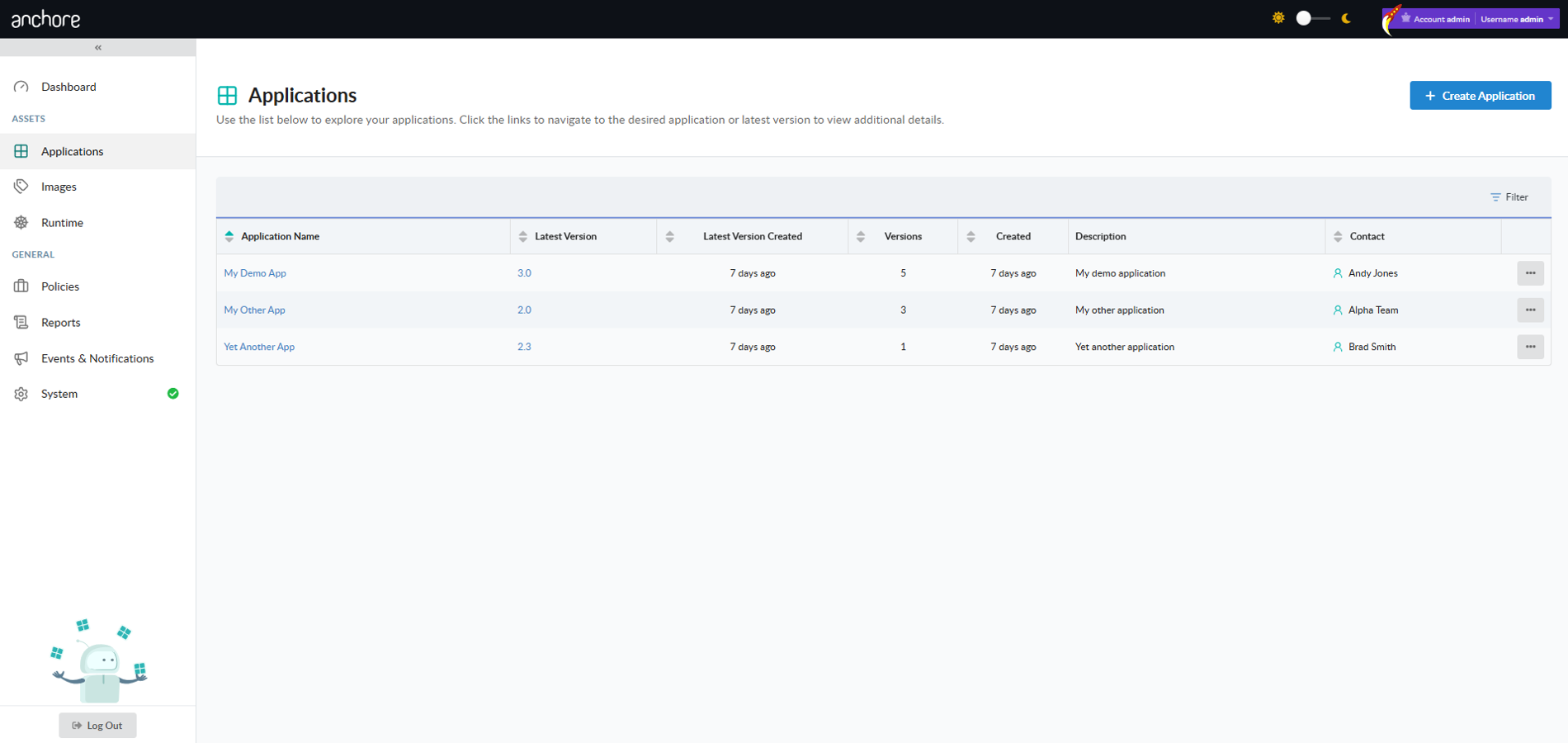
The Apps view is the home for app management in the UI. From there you can browse every app in your current account, drill into a specific app to see its versions, and trigger the create / edit / delete flows from a single screen.
Create an App in the GUI
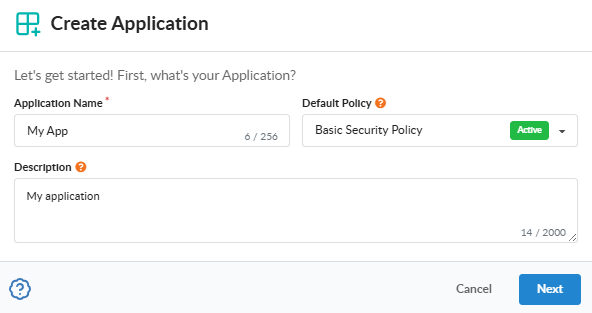
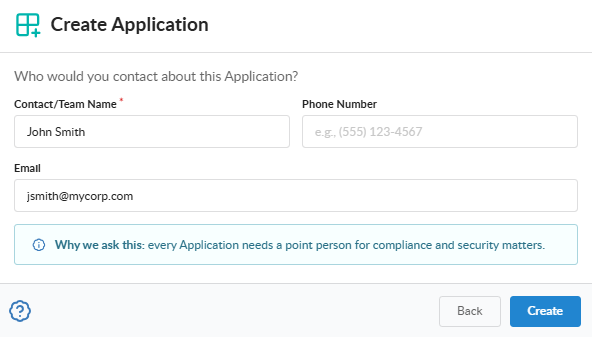
Click Create App in the Apps view to open the creation modal. Provide a name, an optional description, a contact (name required, email and phone optional), and an optional policy assignment.
If you leave the policy assignment blank, the app inherits the account’s default policy.
Edit an App in the GUI
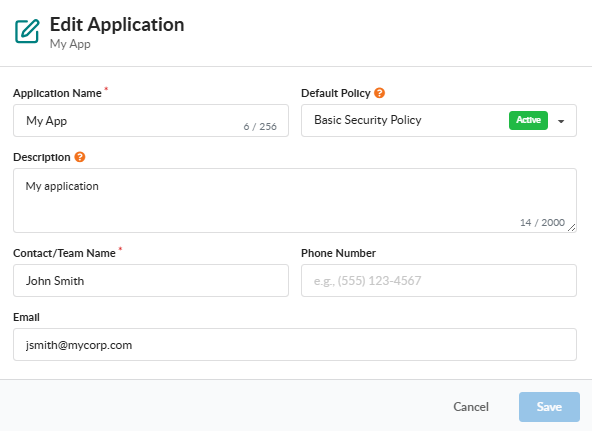
From the Apps view or from an app’s detail page, open the Edit action to update the app’s name, description, contact, or policy assignment. The same field rules apply as on create.
Delete an App in the GUI
Open the Delete action from the Apps view or detail page. If the app still has versions attached, the GUI prompts you to confirm a forced delete that cascades to every version and asset under the app.
Deleting an app with force removes every version of the app and every asset attached to those versions. This operation is irreversible.
Manage Apps with AnchoreCTL
AnchoreCTL exposes the full CRUD surface for apps under anchorectl app. Every command accepts either an app name or its UUID, and the output format is controlled with -o text|json|json-raw|id.
Create an App
Create a new app with the add subcommand. The app name is the positional argument, and the contact name is the only required flag:
Optional flags include --contact-email, --contact-phone, --description, and --policy-id.
List Apps
List every app in the current account with no arguments:
anchorectl app list
To narrow the result to a single app by exact name, add --name:
anchorectl app list --name my-service
Get an App
Retrieve a single app’s record by either its name or UUID:
anchorectl app get my-service
Use -o json for the structured record, which includes system_metadata and the resolved policy_id.
Update an App
Update one or more fields on an existing app. Only the flags you provide are sent — omitted flags leave the corresponding fields unchanged:
anchorectl app update my-service \
--description "Customer-facing API service (regulated)"\
--policy-id strict-policy
To clear the policy assignment and fall back to the account default, pass an empty string: --policy-id "".
Delete an App
Delete an app by name or UUID. The default behavior refuses to delete an app that still has versions attached:
anchorectl app delete my-service
To cascade the delete through every version and every asset under the app, add --force:
anchorectl app delete my-service --force
Manage Apps with the API
App management is exposed under the /apps collection — create, list, get, update, and delete operations are all available, with cascading delete via ?force=true. The full endpoint inventory, request and response schemas, and error codes are in the API browser; search for the Apps tag.
A few conventions worth knowing as you call these endpoints:
List endpoints return paginated responses — see Pagination.
Cross-account requests are scoped via the x-anchore-account header or, from AnchoreCTL, the ANCHORECTL_ACCOUNT environment variable. See Account Scoping for the full mechanism.
DELETE /apps/{app_id}?force=true is destructive and irreversible — it removes every version of the app and every asset attached to those versions.
2.2 - Creating and Managing App Versions
An app version is a point-in-time release of an app: the unit that aggregates packages, vulnerabilities, and policy results across the assets that make up a release. Versions are managed through the Anchore Enterprise GUI, AnchoreCTL, or the Anchore API.
In addition to a name and description, an app version carries two fields that model the release lifecycle:
status — one of in_progress, released, or eol. New versions default to in_progress. Move a version to released when it ships, and to eol once support ends.
release_date — the date the version was released or hosted. Free-form for in_progress versions; typically set when the status moves to released.
Marking a version as eol does not stop analysis: the version continues to receive
vulnerability matches and policy re-evaluations, so its results stay current. However,
Anchore Enterprise no longer sends policy status change notifications for an eol
version. See Notifications for how
notifications are configured.
Manage App Versions in the Anchore Enterprise GUI
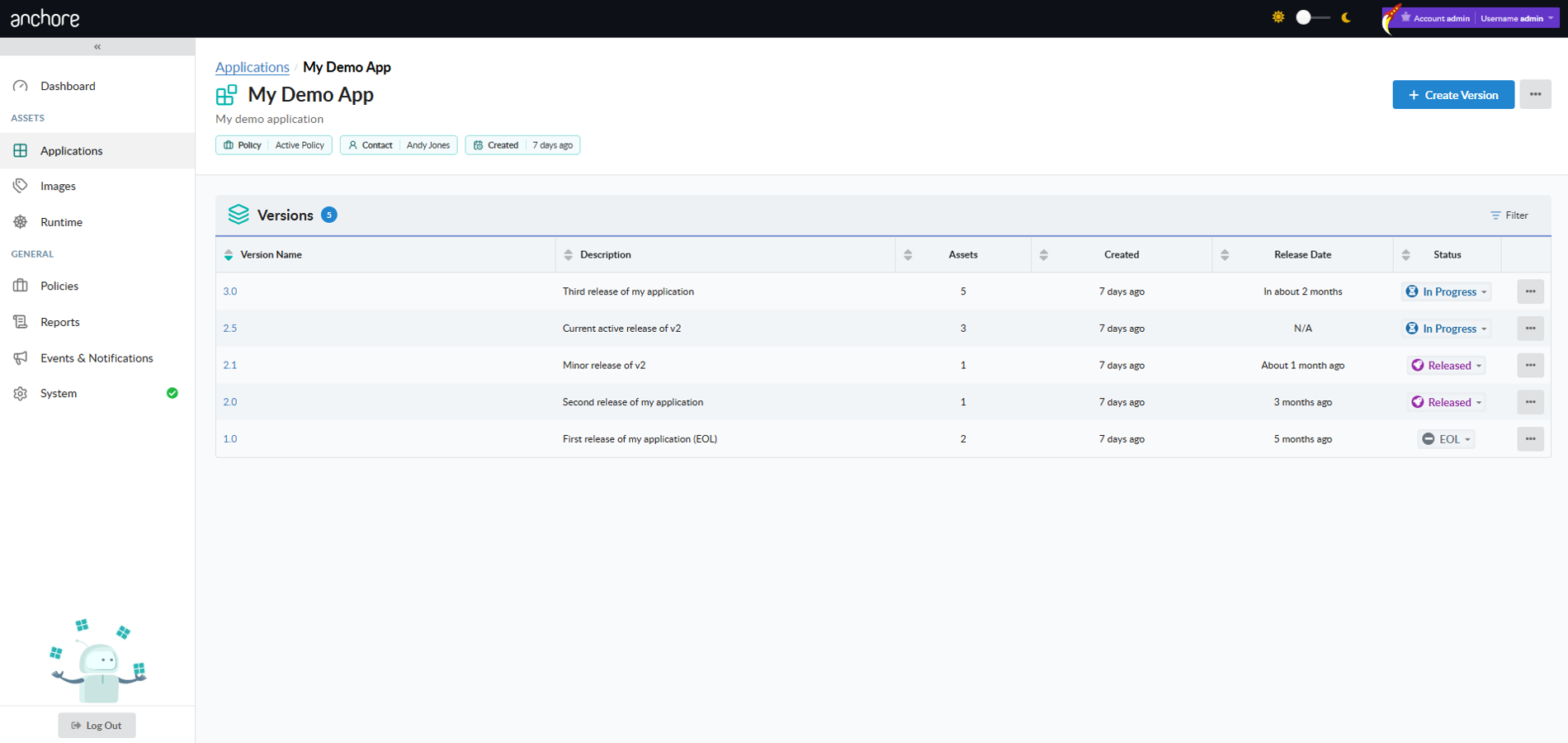
Versions are listed on an app’s detail page in the Apps view. From there you can create a new version, open an existing version’s detail page, or edit and delete versions.
Create a Version in the GUI
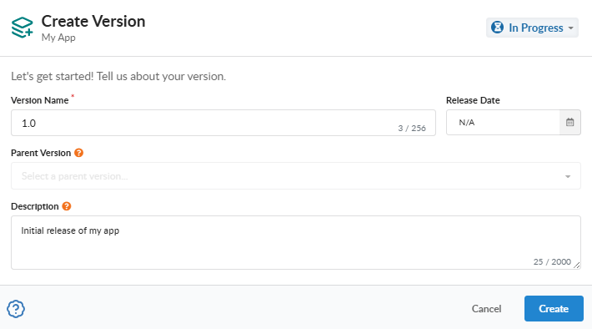
From the app detail page, click Create Version to open the creation modal. Provide a name, an optional description, an optional status, an optional previous version to chain from, and an optional release date.
Edit a Version in the GUI
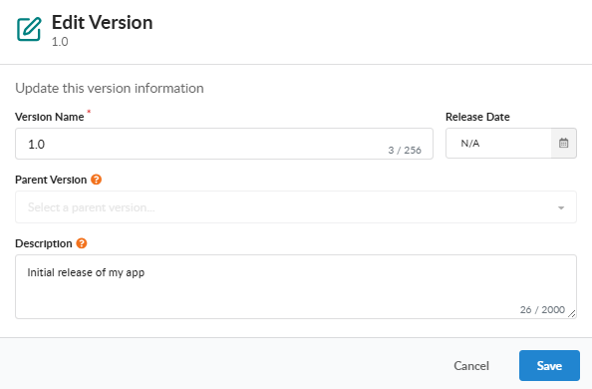
From the app detail page or the version’s own detail page, open the Edit action to update any field.
Delete a Version in the GUI
Open the Delete action from the version row or detail page. If the version still has assets attached, the GUI prompts you to confirm a forced delete that cascades to every asset.
Deleting a version with force removes every asset attached to that version. This operation is irreversible.
Version Detail Page
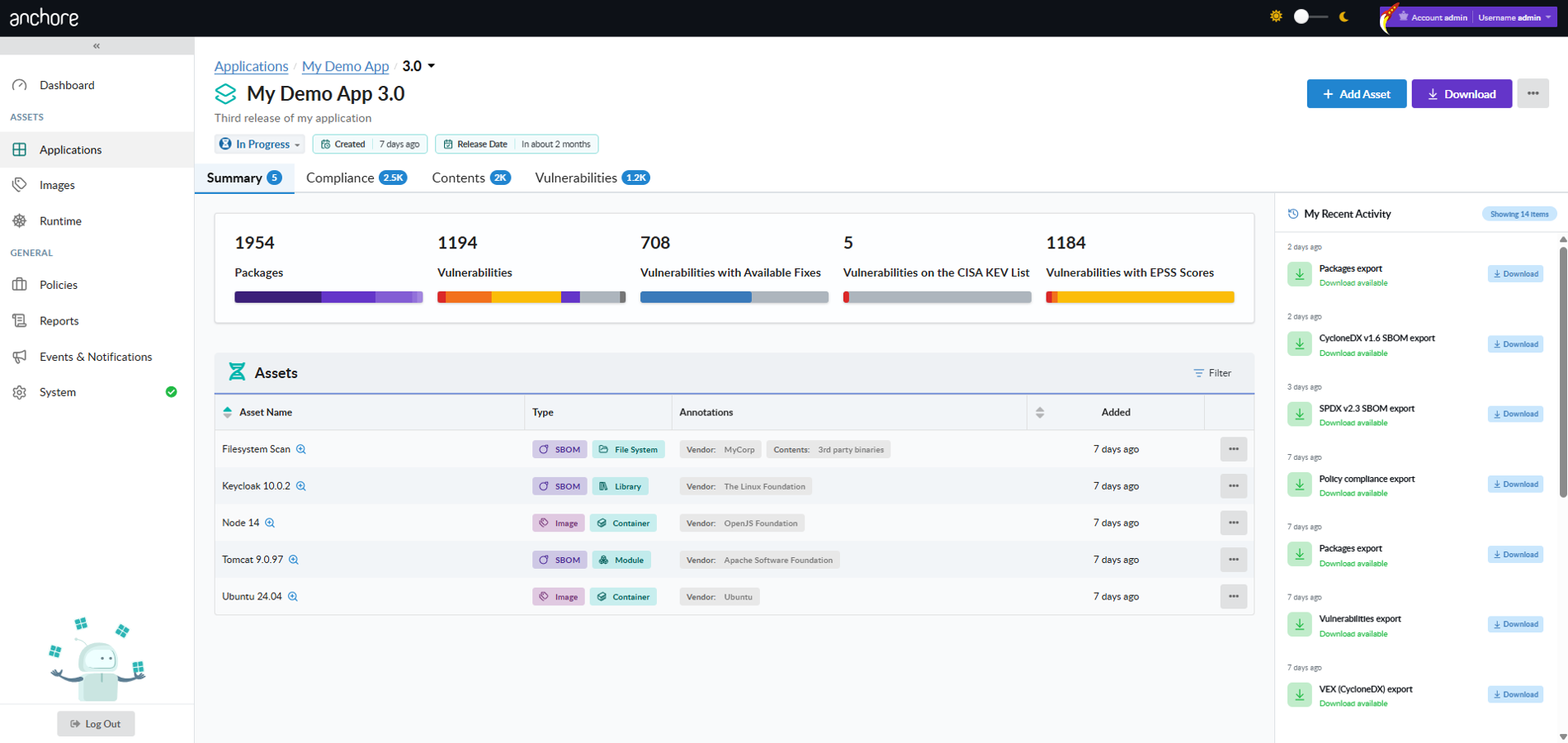
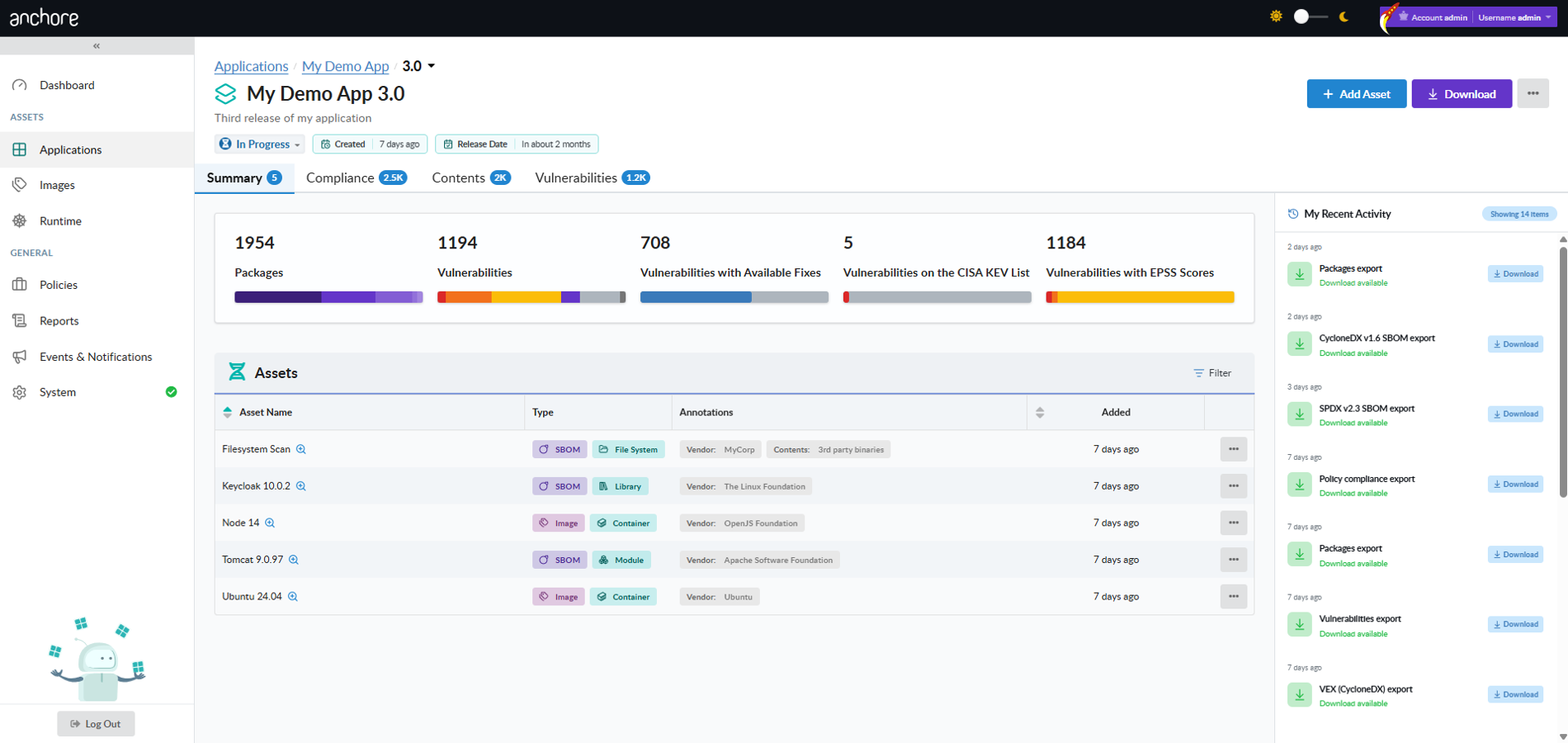
Open a version from the app detail page to land on its detail view. This is the centerpiece of SBOM management in the GUI; it aggregates every asset attached to the version and presents a tabbed view of the version’s overall compliance issues, packages, and vulnerabilities.
The header carries the version’s name, status, release date, and primary actions: Add Asset, Download Unified Documents, and an additional actions menu. The body is organised into tabs that present the same underlying data through different perspectives. Each tab shows a data grid with a unique listing of relevant data. Above the grid are filters which can be used to reduce the data rows based on your desired criteria. Filters can be stacked to create multiple expressions. On the Contents, Vulnerabilities, and Compliance tabs, an Export button next to the Filters downloads the unfiltered grid data into a data file. Each export creates an asynchronous job, and the resulting generated data file can be downloaded via the Recent Activity panel in the Summary tab. Exported CSVs contain one row per entry per asset, with Asset ID, Asset Name, Asset Class, and Asset Type columns identifying which asset each row came from.
Summary Tab
The summary tab gives an at-a-glance view of the version’s compositions and compliance state: list of assets with their metadata, total packages with a breakdown by ecosystem, vulnerability counts with several breakdowns, and a recent activity panel on the right side which shows application version jobs and downloads. It is the ideal landing page for an executive or release-manager glance at the version.
Recent Activity Panel
Every asset-add, export, and policy-evaluation operation runs as an asynchronous job. The version detail page surfaces these through a Recent Activity panel that polls live for status updates and shows each in-flight, completed, or failed job.
Click a row to open the job detail popup, which shows the job type, status, headline message, and, for failed jobs, the error code and reason captured during validation. The same job records are available through anchorectl app job list / get and through the API at /apps/{app_id}/jobs. For the validation error codes you may see on failed SBOM uploads, see Content Validation.
Contents Tab
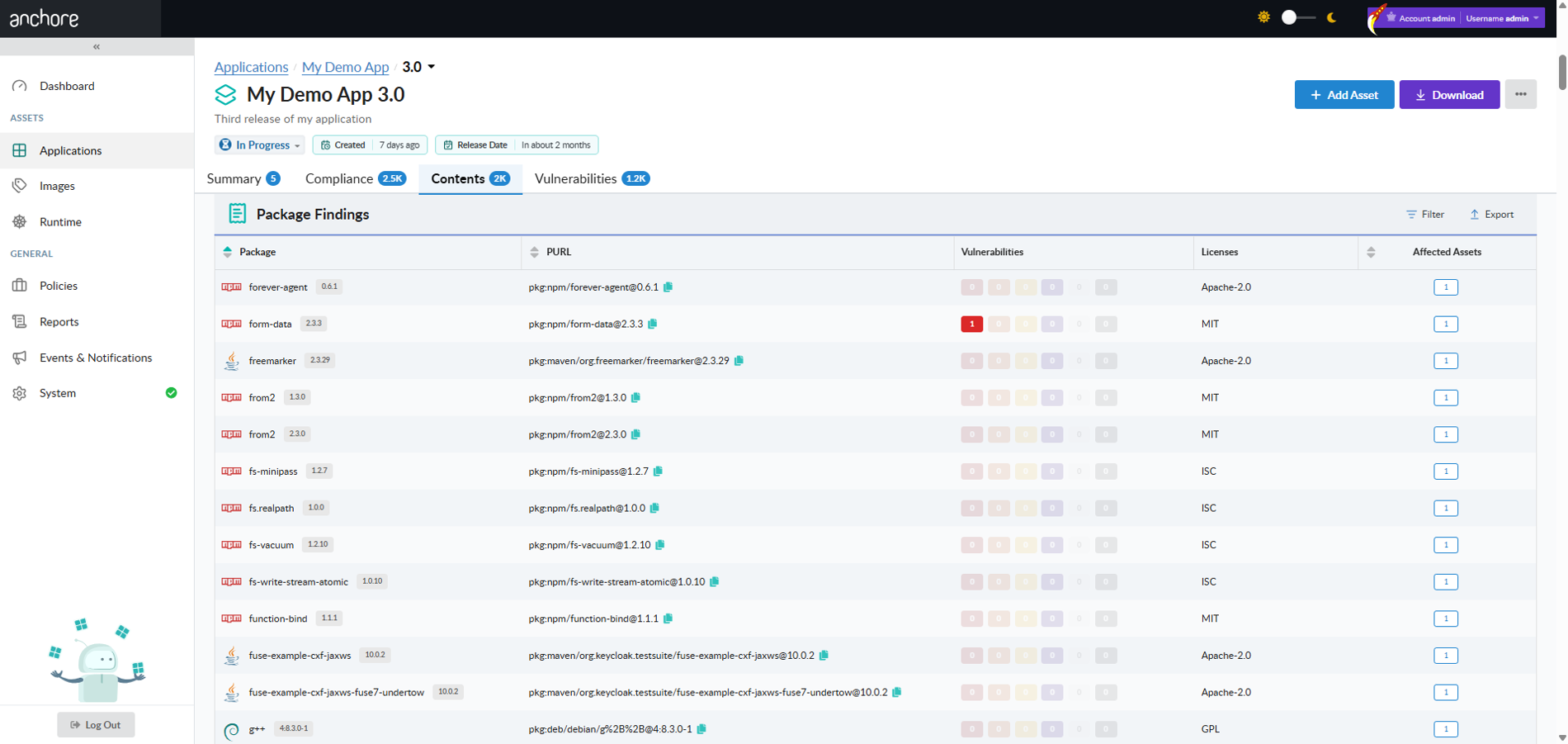
The contents tab lists every unique package found across every asset in the version. Each row presents the package ecosystem, name and version, PURL, a vulnerability summary by severity and count, a list of licenses, and an affected asset count. From a package you can view which assets contain it. This is the GUI equivalent of the assets-by-package API endpoint described in Viewing an App Version’s SBOM. The tab can be filtered by whether a package has vulnerabilities and by vulnerability severity; filter and sort selections are reflected in the URL, so a filtered view can be bookmarked or shared.
Vulnerabilities Tab
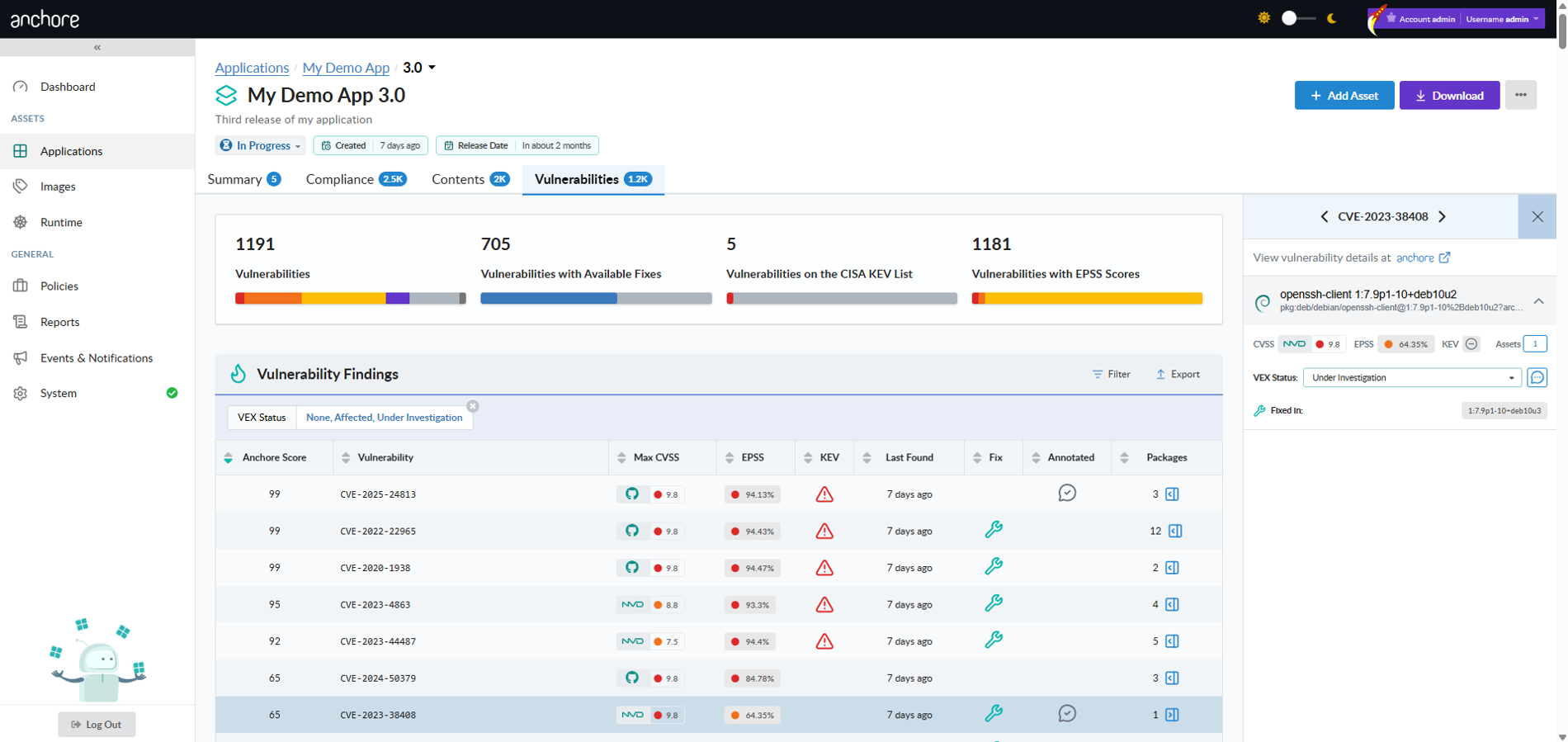
The vulnerabilities tab lists every unique vulnerability surfaced across the version’s assets. Each row presents a unique vulnerability record consisting of the computed Anchore Score (a composite risk index consisting of the CVSS score and severity, the EPSS, and the CISA KEV status, used to prioritize remediation work), vulnerability ID, maximum CVSS severity and score (from a given security repository), the EPSS data, the CISA KEV status, the last time the vulnerability was reported, whether any of the associated packages have fixes available, and whether any of the associated packages have VEX annotations applied to them. Selecting a vulnerability opens a panel that shows which packages are affected and in which assets the impacted package lives. The packages panel can also be used to apply a VEX annotation to provide the security assessment for a given vulnerability-package combination for the current application version.
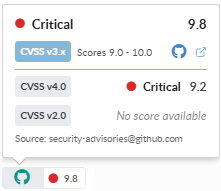
Clicking on any of the Vulnerability widgets will show the vulnerability repository from which the data is being provided, along with CVSS v2.0, v3.1, and v4.0 scores. There is also a link to the
Anchore Vulnerability Database website where you can conduct additional research about any vulnerabilities of interest looking across data aggregated across several providers.
Compliance Tab
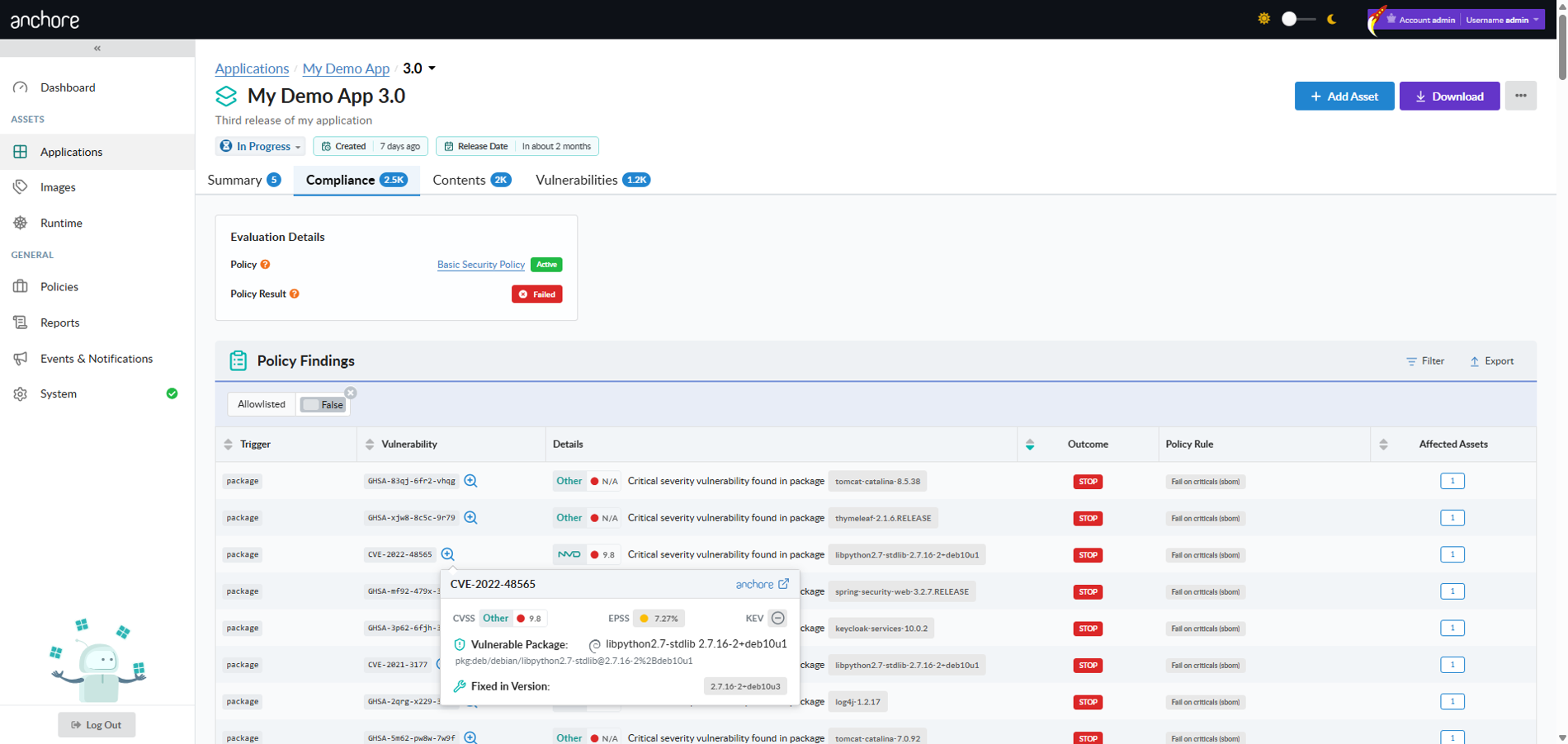
The compliance tab shows the result of the most recent policy evaluation for the version. Findings are grouped by gate and trigger, and a STOP / WARN / GO badge on each finding mirrors what AnchoreCTL would surface from anchorectl app version policy findings list.
Manage App Versions with AnchoreCTL
App versions live under anchorectl app version. Every command requires the parent app via the --app flag and accepts either an app or version name, or its UUID.
Create a Version
Create a new version of an existing app. The version name is the positional argument, and the parent app is identified with --app:
Optional flags include --description, --status, and --release-date. New versions default to in_progress status.
List Versions for an App
List every version of an app, with the app name or UUID as the positional argument:
anchorectl app version list my-service
To narrow the result to a single version by exact name, add --name:
anchorectl app version list my-service --name 1.4.0
Get a Version
Retrieve a single version’s record. The version argument accepts either its name or UUID:
anchorectl app version get 1.4.0 --app my-service
Use -o json for the structured record, which includes system_metadata.
Update a Version
Update one or more fields on an existing version. Only the flags you provide are sent; omitted flags leave the corresponding fields unchanged. This is also how you transition the version’s status through its lifecycle:
anchorectl app version update 1.4.0 \
  --app my-service \
  --status released \
  --release-date 2026-05-15
Delete a Version
Delete a version by name or UUID. The default behavior refuses to delete a version that still has assets attached:
anchorectl app version delete 1.4.0 --app my-service
To cascade the delete through every asset under the version, add --force:
anchorectl app version delete 1.4.0 --app my-service --force
Manage App Versions with the API
App version management is exposed under /apps/{app_id}/versions: create, list, get, update, and delete operations are all available, with cascading delete via ?force=true. The full endpoint inventory, request and response schemas, and error codes are in the API browser; search for the App Versions tag.
A few conventions worth knowing as you call these endpoints:
Pagination on list endpoints is cursor-based; see How It Works.
Status transitions are sent through the same PATCH endpoint as the name and description fields.
The release_date field is an RFC 3339 date-time. AnchoreCTL accepts the shorter YYYY-MM-DD form and converts it.
DELETE /apps/{app_id}/versions/{version_id}?force=true is destructive and irreversible: it removes every asset attached to the version.
2.3 - Managing Assets in an App Version
An asset is an application codebase element that was analyzed and whose SBOM lives inside an app version. It can be an externally supplied SBOM document, a container image, or an analyzed filesystem — all three sit side by side under the same version. The version aggregates packages, vulnerabilities, and policy results across every asset it contains.
Each asset carries a small set of fields:
Field
Required
Purpose
name
Yes
Human-readable identifier, unique within the parent app version
type
Yes
One of the values in the AssetType enum (e.g. container, filesystem, library)
annotations
No
Free-form key=value pairs for build metadata, ownership, environment tags, and so on
system_metadata
Read-only
UUID and created_at / updated_at timestamps
The SBOM content for an asset is fetched separately from the asset record itself.
Add an Asset
Assets are added asynchronously through a job. AnchoreCTL exposes an asset-add command per attachment path; the choice depends on what you’re attaching:
SBOM — upload an existing CycloneDX, SPDX, or Syft-native SBOM produced outside Anchore Enterprise. See Managing SBOM Assets.
Filesystem — analyze a directory tree locally (i.e., source repo, build artifact dir, or a mounted VM) and upload the resulting SBOM. See Managing Filesystem Assets.
Analysis bundle — attach an analysis previously generated with anchorectl generate analysis-bundle (see Generating SBOMs), decoupling local analysis from the upload. See Attaching Analysis Bundle Assets.
For the job lifecycle — pending → processing → complete / failed / cancelled — and the full distinction between centralized and distributed image analysis, see How It Works.
Manage Assets in the Anchore Enterprise GUI
A version’s detail page lists every asset attached to that version, with each asset’s type, status, and a quick path to its SBOM, packages, and vulnerabilities.
Asset Detail Popup
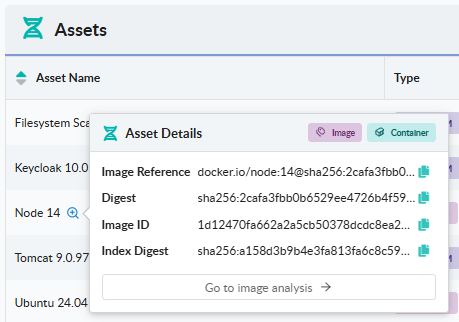
Selecting an asset on the version’s assets list opens a drill-in popup that shows the asset’s metadata. If the asset is an Image, click Go to image analysis to open the advanced images GUI. There you can review additional image details, assess advanced policies like FedRAMP or NIST 800-53, and view STIG results.
Edit an Asset in the GUI
Open an asset’s row action menu to edit its attributes — for example, choose Edit Annotations to manage the key=value annotations on the asset. Annotations are merged with what’s already there; clear a single key by setting its value to empty.
Delete an Asset in the GUI
From the version detail page, open the Delete action on the asset row. Deleting an asset removes it and its SBOM from the version; it does not affect any other asset or version.
Manage Assets with AnchoreCTL
Asset CRUD lives under anchorectl app version asset. Every command requires the parent app and version via --app and --version.
List Assets in a Version
List every asset attached to a specific version. The version name or UUID is the positional argument, and the parent app is identified with --app:
anchorectl app version asset list 1.4.0 --app my-service
To narrow the result to a single asset by exact name, add --name:
anchorectl app version asset list 1.4.0 --app my-service --name api-image
Get an Asset
Retrieve a single asset’s record. The asset argument accepts either its name or UUID:
anchorectl app version asset get api-image --app my-service --version 1.4.0
Use -o json for the structured record, which includes system_metadata and the asset’s annotations.
Get the SBOM for an Asset
The asset’s stored SBOM is fetched through a separate subcommand. Use --file to write the SBOM to disk, or omit it to write to stdout:
anchorectl app version asset sbom get api-image \
  --app my-service \
  --version 1.4.0 \
  --file api-image.sbom.json
Edit an Asset
Edit an asset’s attributes — annotations, name, or type — with the update subcommand:
--annotations accepts a comma-separated list of key=value pairs. The list is merged with existing annotations; remove a single key by setting its value to empty (key=). Rename the asset with --name, or correct its type with --type.
Delete an Asset
Delete an asset by name or UUID. The version it belongs to is identified with --version, and its parent app with --app:
Deletion is unconditional — there is no --force flag because nothing depends on an asset’s existence other than the version it belongs to.
Manage Assets with the API
Asset management is exposed under /apps/{app_id}/versions/{version_id}/assets — list and get on the collection, get / update / delete on individual assets, and a separate sub-resource for the asset’s SBOM content at /apps/{app_id}/versions/{version_id}/assets/{asset_id}/sbom. Asset creation is performed through the App Jobs endpoints — one job type per add path. The full endpoint inventory, request and response schemas, and error codes are in the API browser; search for the App Version Assets and App Jobs tags.
A few conventions worth knowing as you call these endpoints:
The list endpoint returns paginated responses — see Pagination — and accepts ?name=<exact-name> and ?type=<AssetType> filters.
Cross-account requests are scoped via the x-anchore-account header or ANCHORECTL_ACCOUNT environment variable. See Account Scoping for the full mechanism.
The query endpoints under the same version path — packages and assets-by-package — answer cross-asset questions about a release. They are covered in Viewing an App Version’s SBOM; the vulnerability-side queries (vulnerabilities, packages-by-vulnerability) are covered in Scan an App Version.
2.3.1 - Managing SBOM Assets
An SBOM asset is created by uploading an SBOM that was produced outside Anchore Enterprise — by a vendor, a different SCA tool, or a custom build pipeline — and attaching it to an app version. Use this path when you already have an SBOM in hand and want to bring it into Anchore Enterprise’s vulnerability and policy analysis without re-scanning the underlying artifact.
The same upload path also serves as the GUI equivalent for filesystem-derived SBOMs — generate the SBOM with a tool of your choice, then upload it here.
Supported Formats
Anchore Enterprise accepts CycloneDX (JSON or XML), SPDX (JSON or tag-value), and Syft native JSON documents. The supported versions of each format are listed in Supported SBOM Formats.
Content Validation
Anchore Enterprise runs every uploaded SBOM through a multi-stage validation pipeline before extracting its packages into the app version’s catalog. The pipeline runs as the first step of the upload job; if any stage fails, the job moves to failed with the specific error captured on the job record.
The stages are:
Format detection — the document is classified as CycloneDX, SPDX (2.x or 3.0), or Syft based on identifying markers in the document head. Documents that match none of the supported formats are rejected before any parser runs.
Structural parsing — the format-specific parser deserialises the document. Anchore Enterprise uses the cyclonedx-python-lib library for CycloneDX, spdx-tools for SPDX, and a native parser for Syft. Invalid JSON, malformed XML, missing required fields, or wrong root elements are rejected at this stage.
Version support — for CycloneDX uploads, the declared specVersion must fall within the supported range. Documents declaring an unsupported version are rejected even if they otherwise parse cleanly.
Content ingestion — only after the previous stages pass does Anchore Enterprise extract packages and dependencies from the document and insert them into the app version.
When the job fails, the error record carries one of the following codes alongside a human-readable reason:
Code
Meaning
AS510
Generic SBOM parse failure (no format-specific code applies)
AS511
SPDX parse failure
AS512
CycloneDX JSON parse failure
AS513
CycloneDX specVersion outside the supported range
AS514
CycloneDX XML is malformed
AS515
Document does not match any recognised SBOM format
AS516
Syft document failed structural parsing
You can inspect the failure detail for a job through any of the three surfaces. From the GUI, open the Recent Activity panel on the version detail page and click the failed job to see the error code and reason. From the API, GET /apps/{app_id}/jobs/{job_id} returns the same record. From AnchoreCTL, retrieve the job by its ID:
anchorectl app job get <job-id> --app my-service
Upload an SBOM Asset in the Anchore Enterprise GUI
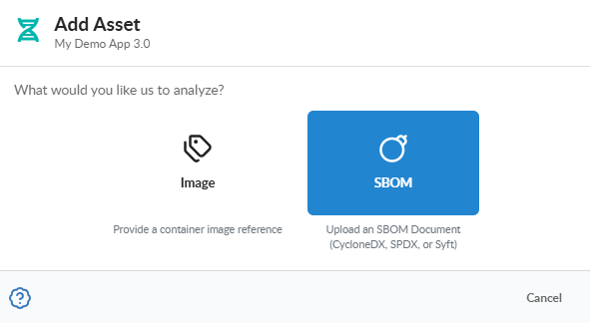
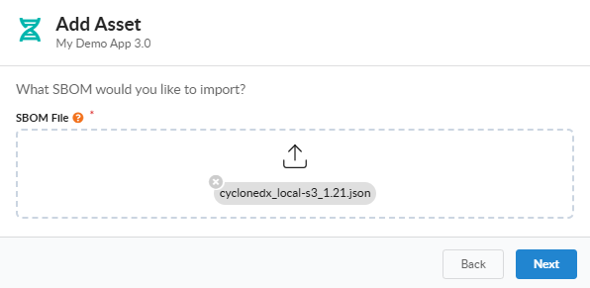
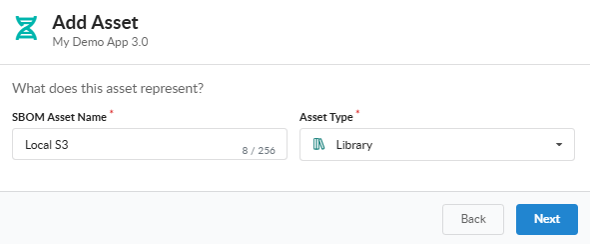
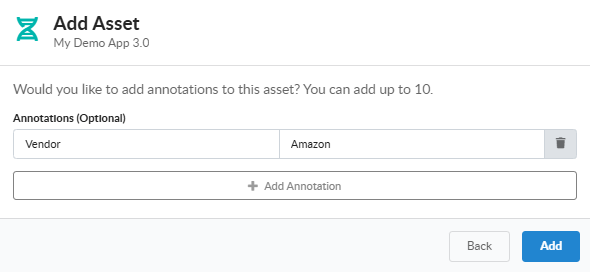
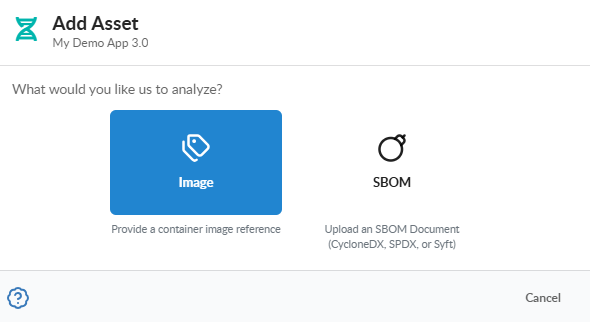
From an app version’s detail page, open the Add Asset action and choose SBOM. The GUI walks through a short three-step wizard: pick the SBOM file from disk, supply the asset’s name and type, and optionally add annotations. The asset’s type tells Anchore Enterprise what the SBOM describes — a container, a filesystem, a library, an application, and so on — and is selected from the same AssetType enum used everywhere else.
Select the SBOM option:
Select the desired SBOM document:
Enter the SBOM Asset Name:
Optionally, enter up to 10 SBOM asset annotations:
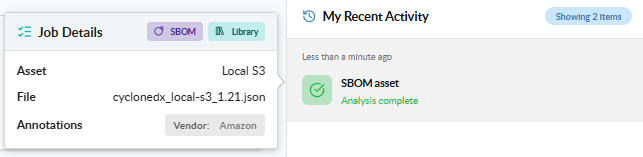
You can view the recently added assets in the My Recent Activity panel on the App Version Summary tab:
Upload an SBOM Asset with AnchoreCTL
Use app version asset add sbom to upload a CycloneDX, SPDX, or Syft-native document to an app version. The SBOM file path is the positional argument; the parent app, parent version, and asset name are required:
Unlike the container-image and filesystem add commands, add sbom cannot infer the asset’s type from the input — the SBOM document describes its components, but Anchore Enterprise does not assume what the whole asset represents. The flag defaults to unknown. Set it explicitly to one of the AssetType values so downstream queries and filters work as expected:
By default the command submits the job and returns immediately. To block until the job reaches a terminal state — useful in CI pipelines where you want validation to gate later steps — add --wait:
POST /apps/{app_id}/jobs/add-sbom-asset — multipart form-data carrying the asset name, the parent version ID, the SBOM document, an asset_type value, and optional annotations.
The full request and response schemas are in the API browser; search for the App Jobs tag. The same endpoint is used by AnchoreCTL’s filesystem and distributed container-image flows after local SBOM generation, so a direct API caller can replicate any of those flows by generating an SBOM client-side and submitting it here with the appropriate asset_type.
A few conventions worth knowing as you call this endpoint:
Schema validation runs before the job leaves pending; a malformed document moves the job to failed with the validation error in the job record.
Job state transitions and polling are documented in How It Works.
Cross-account requests are scoped via the x-anchore-account header or, from AnchoreCTL, the ANCHORECTL_ACCOUNT environment variable. See Account Scoping for the full mechanism.
SBOMs produced by AnchoreCTL’s distributed container-image or filesystem analysis are uploaded automatically by those commands. Use this page when you have an SBOM produced outside of AnchoreCTL — by a vendor, by Syft directly, by another SCA tool, or by a custom pipeline.
2.3.2 - Managing Container Image Assets
A container image asset is created by analyzing an OCI or Docker image and attaching the resulting SBOM to an app version. Anchore Enterprise supports two analysis paths — pick the one that matches where the image bytes can be read from.
This page covers attaching a container image to an app version. The standalone advanced image analysis workflow — scanning an image without binding it to an app — is also fully supported in v6 through the Images view in the Anchore Enterprise GUI and the anchorectl image add command. See Image Analysis for that path. Use this page when you want a container image to participate in app-version aggregation, pivot queries, and exports.
Distributed vs Centralized Analysis
Path
Who pulls the image
Who generates the SBOM
When to use
Distributed
AnchoreCTL, on the host where you run the command
AnchoreCTL, locally; only the SBOM is uploaded
Offloading SBOM-generation load from the central deployment, air-gapped or sensitive-image pipelines, registries Anchore Enterprise cannot reach
Centralized
Anchore Enterprise, from the registry
Anchore Enterprise, server-side
Registries Anchore Enterprise can reach, when you want consistent server-side analysis without local resource use
For the underlying lifecycle these two paths share, see How It Works.
Distributed analysis can also be split into two steps. AnchoreCTL generates an analysis bundle on the host where it runs, which needs access to the image but no connection to Anchore Enterprise (see Generating SBOMs). The bundle is then attached to the app version later, either as a discrete pipeline step or once network connectivity to the Anchore Enterprise deployment is available (see Attaching Analysis Bundle Assets).
Add a Container Image Asset in the Anchore Enterprise GUI
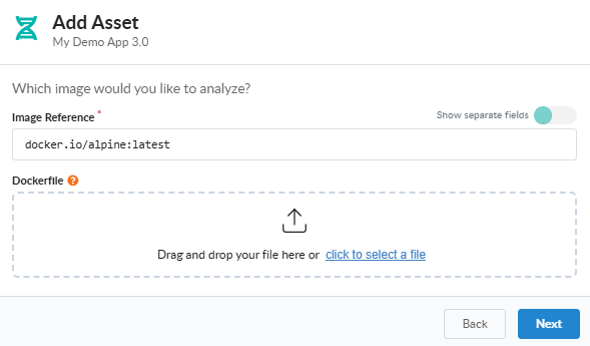
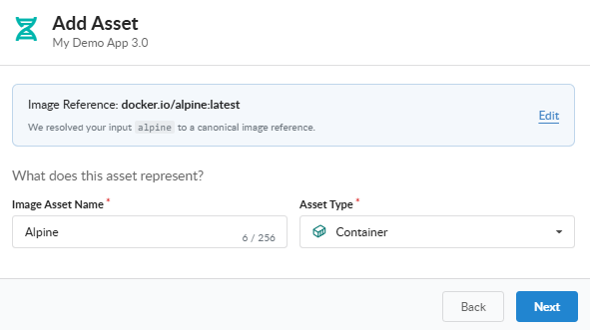
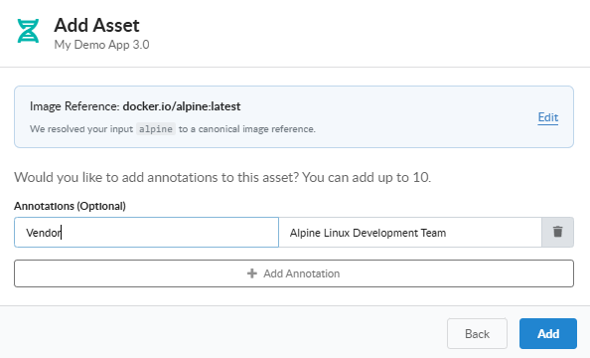
From an app version’s detail page, open the Add Asset action and choose Container Image. Provide the image reference, an asset name, and (optionally) a Dockerfile to attach and annotations. The GUI submits the analysis job and shows its progress on the version’s recent activity panel.
Select the Image option:
Enter the Image Reference and optional Dockerfile:
Enter the Image Asset Name:
Optionally, enter up to 10 image asset annotations:
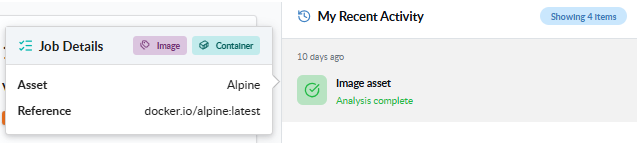
You can view the recently added assets in the My Recent Activity panel on the App Version Summary tab:
Add a Container Image Asset with AnchoreCTL
AnchoreCTL exposes the two analysis paths as separate subcommands. Both require the parent app, the parent version, and a name for the new asset.
Distributed Analysis
Use app version asset add container-image to have AnchoreCTL analyze the image locally and upload the SBOM. The default source is a registry pull:
Switch the source with --from. The supported values are:
Source
--from value
Notes
Registry (default)
omit, or registry
AnchoreCTL pulls the image from the registry
Local Docker daemon
docker
Reads an image already loaded into Docker
Local Podman storage
podman
Reads an image already loaded into Podman
OCI/Docker archive
docker-archive:/path/to.tar
Loads the image from a local tar file
To analyze an image already loaded into your local Docker daemon — for example a freshly built image that hasn’t been pushed yet — point AnchoreCTL at the docker source:
The image reference must be resolvable from Anchore Enterprise — including registry credentials configured in your account. The centralized command does not accept --from or --platform, since Anchore Enterprise selects how to fetch the image.
Shared Flags
Both subcommands accept the same supporting flags:
--annotations "key=value,key=value" — attach build metadata at create time (see Managing Assets in an App Version for the merge and clear semantics)
--dockerfile /path/to/Dockerfile — attach the Dockerfile so policy checks can evaluate Dockerfile triggers
--wait — block until the job reaches a terminal state instead of returning immediately
--type — override the asset type (defaults to container); see the AssetType enum
These flags stack with both the distributed and centralized invocations. A complete CI/CD-friendly invocation that attaches a Dockerfile, captures build metadata, and blocks until the job completes:
Distributed and centralized analysis are two distinct job types in the API:
POST /apps/{app_id}/jobs/add-container-image-asset — used by the centralized path; Anchore Enterprise pulls and analyzes the image server-side.
POST /apps/{app_id}/jobs/add-imported-image-asset — used by the distributed path; AnchoreCTL analyzes the image locally and uploads the resulting SBOM together with the image manifest, image config, and any optional analysis artifacts (secret searches, content searches, file contents) as a multipart payload.
For both, the full multipart request schema and response schemas are in the API browser; search for the App Jobs tag.
A few conventions worth knowing as you call these endpoints:
Job state transitions and the --wait semantics are documented in How It Works.
The job response carries a job_id; poll GET /apps/{app_id}/jobs/{job_id} to track status.
Cross-account requests are scoped via the x-anchore-account header or, from AnchoreCTL, the ANCHORECTL_ACCOUNT environment variable. See Account Scoping for the full mechanism.
Server-side analysis depends on Anchore Enterprise being able to reach your registry and authenticate. Configure registry credentials in your account before submitting centralized jobs against private registries.
2.3.3 - Managing Filesystem Assets
A filesystem asset is created by analyzing a local directory tree and attaching the resulting SBOM to an app version. Use this path when the software you want to track is a build output, an unpacked archive, a virtual machine root, or any directory of files that does not live inside a container image.
Filesystem analysis happens on the host where you run AnchoreCTL: AnchoreCTL generates the SBOM locally and uploads the resulting document to Anchore Enterprise. To attach a filesystem-derived SBOM through the Anchore Enterprise GUI, generate the SBOM first and upload it via Managing SBOM Assets with the asset type set to filesystem.
Filesystem Assets in the Anchore Enterprise GUI
The GUI surfaces a filesystem asset once an app version asset add filesystem job completes — it appears in the version’s asset list alongside any other assets, with its type displayed as filesystem. For an ad-hoc upload of a pre-generated filesystem SBOM, use the GUI’s Add Asset → SBOM action with the asset type set to filesystem.
Add a Filesystem Asset with AnchoreCTL
Use app version asset add filesystem to analyze a directory and upload the resulting SBOM. AnchoreCTL runs Syft locally to generate the SBOM, then submits it to Anchore Enterprise as a job. To analyze now and upload later, for example from a build stage with no Anchore Enterprise connectivity, generate an analysis bundle instead; see Generating SBOMs.
The directory path is the positional argument. The parent app, version, and asset name are required:
The asset type defaults to filesystem, so you typically do not need to set --type explicitly.
Set SBOM Document Author and Supplier
The generated SBOM document carries an author and a supplier field that downstream consumers (and SBOM quality checks) use to identify provenance. Both default to unknown. Set them with --author and --supplier:
--author follows the common Name <email> form. Both fields are free-text; pick values that match what your organization publishes for software provenance.
Annotate the Asset
Attach build metadata at create time with --annotations. The full merge and clear semantics are documented under Managing Assets in an App Version:
By default the command submits the job and returns immediately, leaving you to track progress through the asset list or job endpoint. To block until the job reaches a terminal state — useful in CI pipelines where you want the job’s outcome to gate later steps — add --wait:
Filesystem analysis happens on the AnchoreCTL host; only the resulting SBOM is sent to Anchore Enterprise. Under the hood, AnchoreCTL uploads the SBOM through the same job type used for any externally produced SBOM:
POST /apps/{app_id}/jobs/add-sbom-asset — the multipart request carries the asset name, the parent version ID, the SBOM payload, and an asset_type of filesystem.
The full request and response schemas are in the API browser; search for the App Jobs tag. If you are integrating directly with the API rather than using AnchoreCTL, you are responsible for running an SBOM generator (Syft or equivalent) against the filesystem and submitting the resulting document.
A few conventions worth knowing as you call this endpoint:
Job state transitions are documented in How It Works.
The job response carries a job_id; poll GET /apps/{app_id}/jobs/{job_id} to track status.
Cross-account requests are scoped via the x-anchore-account header or, from AnchoreCTL, the ANCHORECTL_ACCOUNT environment variable. See Account Scoping for the full mechanism.
2.3.4 - Attaching Analysis Bundle Assets
An analysis bundle is a portable tar archive produced by anchorectl generate analysis-bundle, capturing the result of a local analysis so it can be attached to an app version later, from a different host, network, or pipeline stage. Producing a bundle is covered in Generating SBOMs; this page covers attaching one.
Two bundle types exist, matching the two locally analyzed asset paths:
Container image bundles — carry the full analysis document set: the SBOM plus the image manifest, image config, and any secret search, content search, and retrieved-file results.
Filesystem bundles — carry the SBOM generated from a local directory tree.
Upload an Analysis Bundle with AnchoreCTL
Attach a bundle of either type with app version asset add analysis-bundle. The bundle path is the positional argument; the parent app, version, and asset name are required:
The two bundle types behave slightly differently at upload:
Image bundles are validated locally before anything is sent (every expected document present and well formed), and the image reference is recovered from the SBOM inside the bundle, so the image is never re-pulled. The asset type defaults to container.
Filesystem bundles upload the contained SBOM. Set --type filesystem so the asset is typed correctly in the version’s asset list.
The shared asset-add flags apply here too: --annotations attaches build metadata at create time (see Managing Assets in an App Version for the merge and clear semantics), and --wait blocks until the job reaches a terminal state, which is useful when a CI stage should gate on the outcome:
There is no separate bundle job type. AnchoreCTL unpacks the bundle client-side and routes its contents to the same App Jobs endpoints used by direct analysis:
Image bundles → POST /apps/{app_id}/jobs/add-imported-image-asset, the same multipart payload as distributed image analysis: the SBOM together with the image manifest, image config, and any optional analysis artifacts.
Filesystem bundles → POST /apps/{app_id}/jobs/add-sbom-asset, the same job used for any externally produced SBOM.
The full request and response schemas are in the API browser; search for the App Jobs tag.
A few conventions worth knowing as you call these endpoints:
The job response carries a job_id; poll GET /apps/{app_id}/jobs/{job_id} to track status. Job state transitions are documented in How It Works.
Cross-account requests are scoped via the x-anchore-account header or, from AnchoreCTL, the ANCHORECTL_ACCOUNT environment variable. See Account Scoping for the full mechanism.
3 - Generating SBOMs
Anchore Enterprise generates SBOMs in two ways:
During asset attachment — the SBOM is generated as part of attaching an asset to an app version, and is stored against the version immediately.
Standalone, into an analysis bundle — the SBOM is written to a local archive with no connection to Anchore Enterprise, ready to be attached later.
This page covers producing the SBOM, whilst the asset pages cover attaching the resultant SBOM to a version.
Generate an SBOM When Attaching an Asset
When an asset is attached directly, where generation happens depends on the asset. AnchoreCTL generates the SBOM locally when it can read the source itself, such as a filesystem directory or a container image analyzed on your host, while centralized image analysis generates it server-side. For anything else, generate the SBOM with your own tooling and upload it as an SBOM asset. Either way, the SBOM is stored against the version where it becomes available for vulnerability analysis, policy evaluation, search, and export.
Generate an Analysis Bundle
anchorectl generate analysis-bundle runs the same local analysis as the corresponding app version asset add command, but writes the result set to an uncompressed tar archive instead of uploading it. Generating a bundle requires no connection to Anchore Enterprise; only the later attachment step does. Use bundles when analysis has to happen where the artifact lives (a build stage without Anchore Enterprise credentials, or an isolated or air-gapped network) and the attachment happens somewhere else.
--output-file is required for both bundle types; add --overwrite to replace an existing file.
Generate a Container Image Bundle
An image bundle carries the full analysis document set: the SBOM plus the image manifest, image config, and any secret search, content search, and retrieved-file results. Attaching one is equivalent to running distributed image analysis with the analysis and upload split into two steps, so no analysis fidelity is lost by going through a bundle.
The image source options match distributed image analysis: --from accepts registry (the default), docker, podman, or docker-archive:/path/to.tar, and --platform pins the architecture for multi-platform images. With the docker and podman sources, an image not present in the daemon is pulled from the registry.
The command prints the gathered file metadata and a success or failure line; the analysis documents themselves are written only to the archive. Add -o json for machine-readable output. The SBOM inside an image bundle is always Syft-native JSON, which is the format the upload API requires.
Generate a Filesystem Bundle
A filesystem bundle carries the SBOM generated from a local directory tree. The directory to analyze is the positional argument:
The SBOM inside a filesystem bundle defaults to Syft-native JSON. Choose a different document format with -o: cyclonedx-json, cyclonedx-xml, spdx-json, spdx-tag-value, or syft-json.
Attach the Bundle
A generated bundle is attached to an app version with anchorectl app version asset add analysis-bundle, from any host that can reach Anchore Enterprise. The upload behavior for each bundle type and the underlying API endpoints are covered in Attaching Analysis Bundle Assets.
4 - Viewing an App Version's SBOM
Once an app version contains one or more assets, Anchore Enterprise aggregates the SBOM contents of every asset into a single package view for the version. Viewing that aggregate is how you look inside the stored SBOM: which packages a release contains and which assets carry them. Questions like “which images in this release contain openssl 3.0.13?” can be answered with a single API call.
A package that appears in more than one asset is listed once. A pivot query then shows you which assets contain it.
List every package across every asset in the version, deduplicated by name, version, type, and namespace. The command requires the parent app via --app and accepts either the version name or its UUID:
anchorectl app version package list 1.4.0 --app my-service
Use -o json for the structured record.
AnchoreCTL exposes the aggregate package list only. To find which assets contain a given package, use the assets-by-package API endpoint described below, or the affected-assets view on the version’s contents tab in the Anchore Enterprise GUI.
View SBOM Contents with the API
The API exposes the aggregate package list plus the pivot queries that link packages back to the assets that contain them.
Aggregate List Endpoint
Method
Path
Purpose
GET
/apps/{app_id}/versions/{version_id}/packages
Every package across every asset in the version
Pivot Endpoint
The pivot endpoint answers the cross-asset question that motivates grouping in the first place — locating which assets carry a package.
List assets that contain a specific package (filter by name and version, optionally narrowing by type or namespace)
The full request and response schemas for both the aggregate and pivot endpoints are in the API browser; search for the App Version Packages tag.
A few conventions worth knowing as you call these endpoints:
All list and pivot endpoints return paginated responses — see Pagination.
Cross-account requests are scoped via the x-anchore-account header or, from AnchoreCTL, the ANCHORECTL_ACCOUNT environment variable. See Account Scoping for the full mechanism.
The pivot endpoint is typically the most expensive query in this set. When you only need a count or a simple existence check, prefer the aggregate list with a filter; reach for the pivot when you specifically need the list of affected assets.
5 - Exporting SBOMs
Download a Single Asset SBOM in the Anchore Enterprise GUI
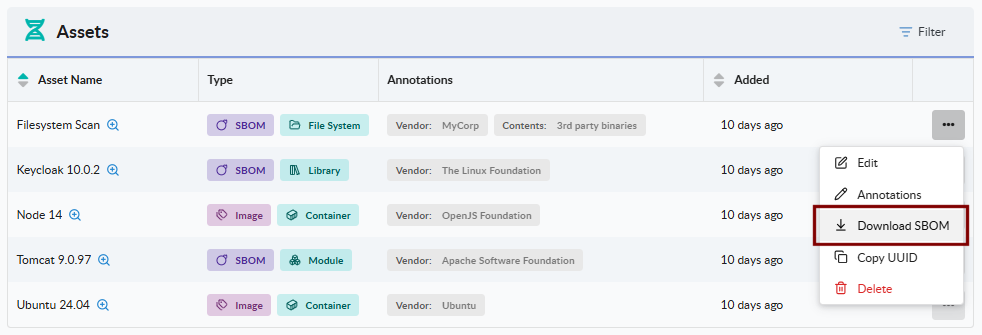
Anchore Enterprise allows users to generate a single Asset SBOM representing a generated SBOM for a container image or a filesystem analysis, or an imported external SBOM. Navigate to the App Version Summary tab, and click on the action menu for the desired asset. Then select the Download SBOM option.
This operation is synchronous and does not use jobs. The downloaded SBOM document will show up in your downloads folder per your browser configuration.
Export a Single Asset SBOM with AnchoreCTL
Retrieve the stored SBOM for a single asset. The asset argument accepts either its name or UUID. Use --file to write the SBOM to disk, or omit it to write to stdout:
anchorectl app version asset sbom get api-image \
  --app my-service \
  --version 1.4.0 \
  --file api-image.sbom.json
Generate a Unified App Version SBOM in the Anchore Enterprise GUI
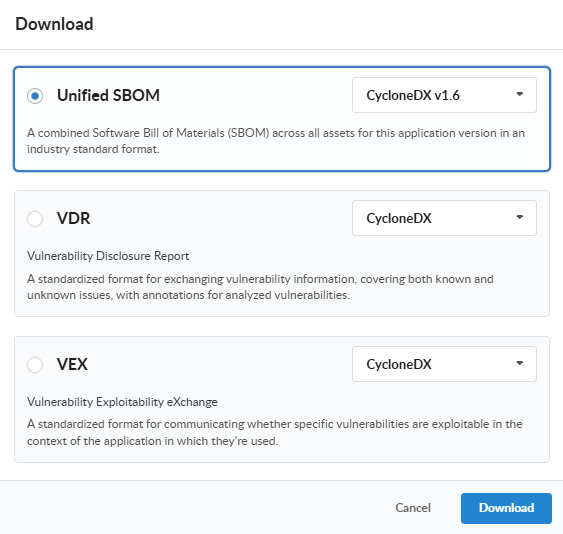
Anchore Enterprise supports the generation of a single unified SBOM document in an industry standard format for the entire app version. The system aggregates and deduplicates all of the packages across every asset attached to the version and saves the result in an SBOM document in the user-selected format (SPDX v2.3 or CycloneDX v1.6).
The app version’s detail page has a Download button in the top-right of the screen which allows the user to select the desired document and format.
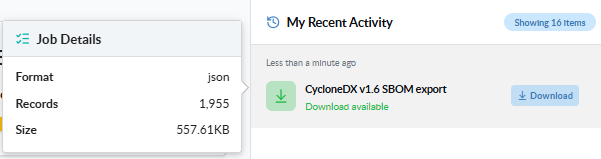
Once the desired options are selected, the GUI submits the download job and shows its progress on the version’s recent activity panel. Once the job completes, click the row in the recent activity panel to download the generated document.
Generate a Unified App Version SBOM with AnchoreCTL
AnchoreCTL hides the job lifecycle behind a single command: it submits the export, waits for the job to reach a terminal state, and streams the exported SBOM to stdout or a file.
Export the combined CycloneDX 1.x SBOM for an app version. The version name or UUID is the positional argument, and the parent app is identified with --app:
anchorectl app version export sbom-cyclonedx-1 1.4.0 --app my-service
By default the exported SBOM is written to stdout. To capture it to a file, pass --file:
Unified App Version SBOM exports run as asynchronous jobs. AnchoreCTL hides this behind a single command, but the API exposes each step so you can integrate exports into a pipeline that needs finer control.
Submit the Export Job
Submit an export by POSTing to the format-specific job endpoint with the app version ID in the request body. The accepted endpoints are:
Format
Endpoint
CycloneDX 1.x
POST /apps/{app_id}/jobs/export-sbom-cyclonedx-1
SPDX 2.x
POST /apps/{app_id}/jobs/export-sbom-spdx-2
The request body accepts optional format and spec_version fields:
Endpoint
format (default)
spec_version (default)
export-sbom-cyclonedx-1
json
1.6
export-sbom-spdx-2
json
2.3
For v6.0 each parameter accepts only the listed value; unsupported pairings are rejected with HTTP 422. The endpoint names leave room for additional CycloneDX 1.x or SPDX 2.x point versions in later releases.
The response carries a job_id.
Poll the Job
GET /apps/{app_id}/jobs/export-sbom-cyclonedx-1/{job_id} (or the SPDX equivalent) returns the current job record. Wait for status to reach a terminal state (complete, failed, or cancelled). When the job is complete, the response carries a completion_detail block whose download_id is the handle for the next step. The job lifecycle is documented in How It Works.
Download the Exported SBOM
Once the job is complete, retrieve the exported SBOM by GETing the download endpoint:
GET /apps/{app_id}/downloads/{download_id}
The endpoint returns:
200 with application/octet-stream — the file is ready and is streamed in the response body
202 while the export job is still processing — useful if you choose to poll the download endpoint directly instead of polling the job
404 if the download_id does not exist or is no longer available
The full endpoint inventory, request and response schemas, and error codes are in the API browser; search for the App Jobs and App Downloads tags.
A few conventions worth knowing as you call these endpoints:
Cross-account requests are scoped via the x-anchore-account header or, from AnchoreCTL, the ANCHORECTL_ACCOUNT environment variable. See Account Scoping for the full mechanism.
The download endpoint is reusable for any export job type, not just SBOM exports — the same handle pattern serves vulnerability, VEX, VDR, package, and policy-compliance exports.
6 - Overriding Package Licenses
The package override feature for license data lets you override license information for specific packages in your Anchore Enterprise deployment. Overrides apply globally within the account — every asset that contains the targeted package surfaces the corrected license data, regardless of which app version or image it appears in.
License Summary Document
Anchore Enterprise provides a per-image license summary document that lists each package alongside its detected license data. Each package entry includes the license identifiers detected at the time of analysis. When the identifier is a valid SPDX expression, additional fields are included — license name, text, header, URL, and copyright.
Retrieve the document with GET /v2/images/{image_digest}/content/licenses.
Any license override data is reflected in the license summary document.
Override License Data
Overrides target a specific package identified by its PURL. Any license field included in the override request is used in place of the upstream-reported license data. Create or update overrides by sending a POST or PUT to /exp/system/package-overrides/licenses.
An override may target one or more of the licenses that the package originally surfaced, or it may target specific license data such as the license text, header, URL, or copyright.
Any override applies globally to any image or asset that contains the specified package.
License Override RBAC Role
A dedicated RBAC role supports the license override feature. The license-override role can be conferred on any user — those users can then create, update, and delete license overrides. The role has a domain value of system and a resource value of license-overrides. The license-override role is not required to view the license summary document.
Users with the system-admin role also have permission to create, update, and delete license overrides.
Anchore Enterprise Experimental API
The license override feature is part of the Anchore Enterprise Experimental API.
Interfaces in this specification are unstable and may change in breaking ways between releases.